A love letter to The NeverEnding Story — the movie that still feels like a secret door
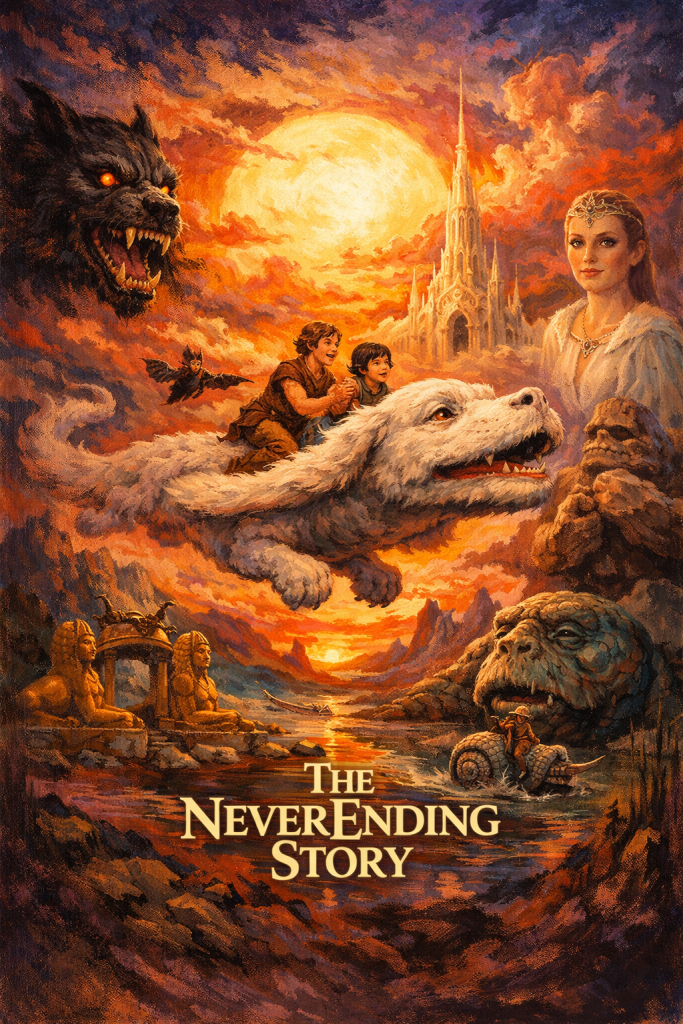
Some movies entertain you, some impress you, and then there are the rare ones that move in—quietly taking up residence in the part of your mind where childhood wonder lives, where hope still feels like a real force, and where imagination isn’t a hobby so much as it is survival. The NeverEnding Story is that kind of movie for me. I can’t think about it without feeling the same mix of warmth and ache, like the memory of a sunset you swear was brighter back then. It’s not just a fantasy film; it’s an emotional time capsule, a reminder that stories can matter enough to change you.
What makes it last isn’t only the unforgettable imagery—though there’s plenty of that, from Falkor gliding through clouds to Atreyu pressing on when everything says stop, to the looming menace of Gmork and the fragile beauty of The Childlike Empress. The deeper reason it stays with me is that it understands loneliness. It understands what it feels like to be a kid (and honestly, sometimes an adult) carrying feelings too big to name. The movie doesn’t talk down to you or apologize for having a heart; it simply reaches out and says, “I know it hurts. Come with me anyway.”
Bastian Balthazar Bux isn’t “cool” or brave in the typical way, and that’s exactly why he matters. He’s grieving, isolated, trying to disappear into pages because reality is too heavy. The film quietly delivers a truth that can be life-saving: escaping into a story doesn’t mean you’re weak. Sometimes it means you’re healing. Sometimes it’s the only way you survive long enough to become yourself. And when the story finally pushes him to stop hiding—when it asks him to choose, to speak, to take part—it feels like it’s asking the same thing of us.
The world of Fantasia is powerful because it isn’t just a backdrop; it’s a place that depends on imagination being treated like it matters. The Nothing isn’t a typical villain as much as it is a feeling—the creeping emptiness that arrives when you stop believing you matter, when life wears you down, when you lose the spark that makes you you. That’s why the film changes as you grow up. As a kid, the adventure thrills you; as an adult, it warns you. It’s telling you not to let the world convince you that wonder is childish, because wonder is armor, wonder is fuel, and wonder is how you keep going.
And then there’s the scene everyone remembers—the one that isn’t there for shock, but because the movie refuses to lie. It doesn’t pretend love automatically saves the day, and it doesn’t pretend bravery means you won’t lose anything. It shows you the kind of pain that leaves a mark, and still says, “Sometimes you keep going anyway.” That’s why Rockbiter hits so hard when he speaks from that hollowed-out place inside him. It’s grief, plain and raw, and strangely validating—because even in a world of luckdragons and ivory towers, the hurt is still real.
I keep coming back to this movie because it reminds me of a time when family films weren’t afraid to be emotionally big—sincere, strange, a little scary, and deeply human. It makes me want to protect that imaginative part of myself like it’s something rare and irreplaceable. And on days when everything feels loud and exhausting, it still whispers something steady: you’re allowed to dream, you’re allowed to believe, and you’re not foolish for wanting a world that’s brighter than the one in front of you.
The older I get, the more I understand the title isn’t just poetic—it’s literal. The story never ends because we never stop needing it. We just change roles. One day you’re the kid hiding in a book, and the next you’re the one trying to keep the light alive—for yourself, for someone else, for the version of you that still looks up at the sky and hopes a luckdragon might come sailing through. And honestly, I still do.